Showing posts with label VincentLo. Show all posts

Tuesday, December 1, 2015

Vincent Lo: Pepakura


Concept

This concept arose in class, and we decided to pursue the idea of Pepakura hands.

Techniques

We started off by creating molds for our hands, and once that was finished, we filled the molds to generate our hand figures. Using Scan Studio, we digitized our figures into scanned data. However, the data was full of holes, so we used Rapidworks to fix them up. We also used Rapidworks to decimate our hands to lower-poly hands. 

At this point, I used Maya to re-topologize my hand using quad draw. I did my best to be efficient with the number of faces while keeping some evenness among them. With a clean and relatively low-poly model, I used Pepakura Designer to layout the mesh. I was able to fit my 2 ft model into a 24x48" sheet. The data was exported into .EPS and .DXF files.

Using Adobe Illustrator, I combined the two files into a single .DXF file, which Rhino can read. After some organization and color coding, I was finally able to setup the appropriate file for laser-cutting.

Materials

For the Keyshot render, I used a gemstone material because I felt it was the most appealing and showed off the faces of the model well. For the sculpture, I used white cardboard for a similar reason. I thought white would be more aesthetically pleasing than brown.

Vincent Lo: Waffle Sculpture


Concept

Waffle sculptures in general remind me of cages, especially when hollowed out. Because of that reason, I came up with the idea of using a bird in a cage as the subject of this piece. My goal was to fit the sculpture type (waffle) with the subject matter.

Techniques

I modeled the cage and the bird stand directly as planes. The bird was a little more complex, so I modeled the bird and smoothed it within Maya. Once I brought the bird into Rhino, I scaled it appropriately and then used Contour to generate the curves. Afterwards, I used PlanarSrf to fill in those newly generated curves. And, of course, after all that I used Intersection and pipes to create the necessary cuts.

Materials

For my Keyshot render, I picked a wood material to loosely check out how the final result would be in cardboard. For the print, I used cardboard for financial reasons.

Vincent Lo: Lamp


I sculpted a rough base mesh in Zbrush


 Once I brought the mesh inside Rhino and generated my curves, I discovered many of them were unusable. I spent some time figuring out what curves were usable, and then I modified them to be more appealing.


Concept

I knew from the start that I wanted the physical illumination of the light to connect with the conceptual aspect of the sculpture. After quite some time, I finally settled on the concept of fire. In addition, I thought this concept of "natural" fire contrasted nicely with "artificial" light.

Techniques

I sculpted my mesh in Zbrush, but then found out quickly that many of the auto-generated curves were unusable. I salvaged what I could, and I did a lot of cleaning and manipulation to the curves. Often I would just re-draw new curves over the old and then scrap the old.

After finding the shapes that I wanted, I blocked out the hole in which the light bulb would rest and scaled things appropriately. To create the slits, I created pipes and placed them on the plane intersections. After all that, I used booleans and splits to make the holes.

Materials

For the Keyshot render, I played around with many materials. I eventually landed on a liquid material and played with the refraction and transparency settings to achieve the current look. For the sculpture, I used cardboard for financial reasons.

Sunday, October 25, 2015

Vincent Lo: Modular Slots

Original Draft

Here are the original designs I had for my modular slots.


I've always been fascinated by Escher's work. I was inspired by his Ascending and Descending to create my first slot design. I originally incorporated the human figure and stairs as those are the essential elements in that piece.

However, I was dissatisfied with my design. I knew that if I put all these pieces together, the end result would be a jumbled, noisy piece, and I wanted the assembled work to feel coherent. After some more planning and thinking, I sketched out new designs for my modular slots. I came up with the following idea to better resemble Escher's Relativity instead of Ascending and Descending.

Final Draft

Here are the final designs I have for my modular slots. 


 I tested out my curves to make sure elements lined up correctly such as the characters' feet when they walk and bottoms when they sit. My design also supports placing characters in different angles which is at the heart of Escher's Relativity.


Concept

In order to elevate my concept beyond a simple mimicry of Escher, I incorporated actions we perform everyday and everywhere. I wanted to demonstrate the disconnectedness prevalent in today's society. Many of us don't speak with the people around us. Instead, we play games on our phones, keep our headphones on to listen to music, and essentially go about our lives without talking to the people physically next to us. I sought to combine the physical disjointedness found within Escher's work with the disjointedness found within today's society.

Techniques

For techniques, I used control point curves. Trim was used to chop away any unneeded edges. I tested the curves to make sure the characters could fit on the steps nicely. I made changes to the original curves if things didn't align correctly.

Materials

I used cardboard for financial reasons.

Monday, October 12, 2015

Vincent Lo: Week 8 "Escaping Time"


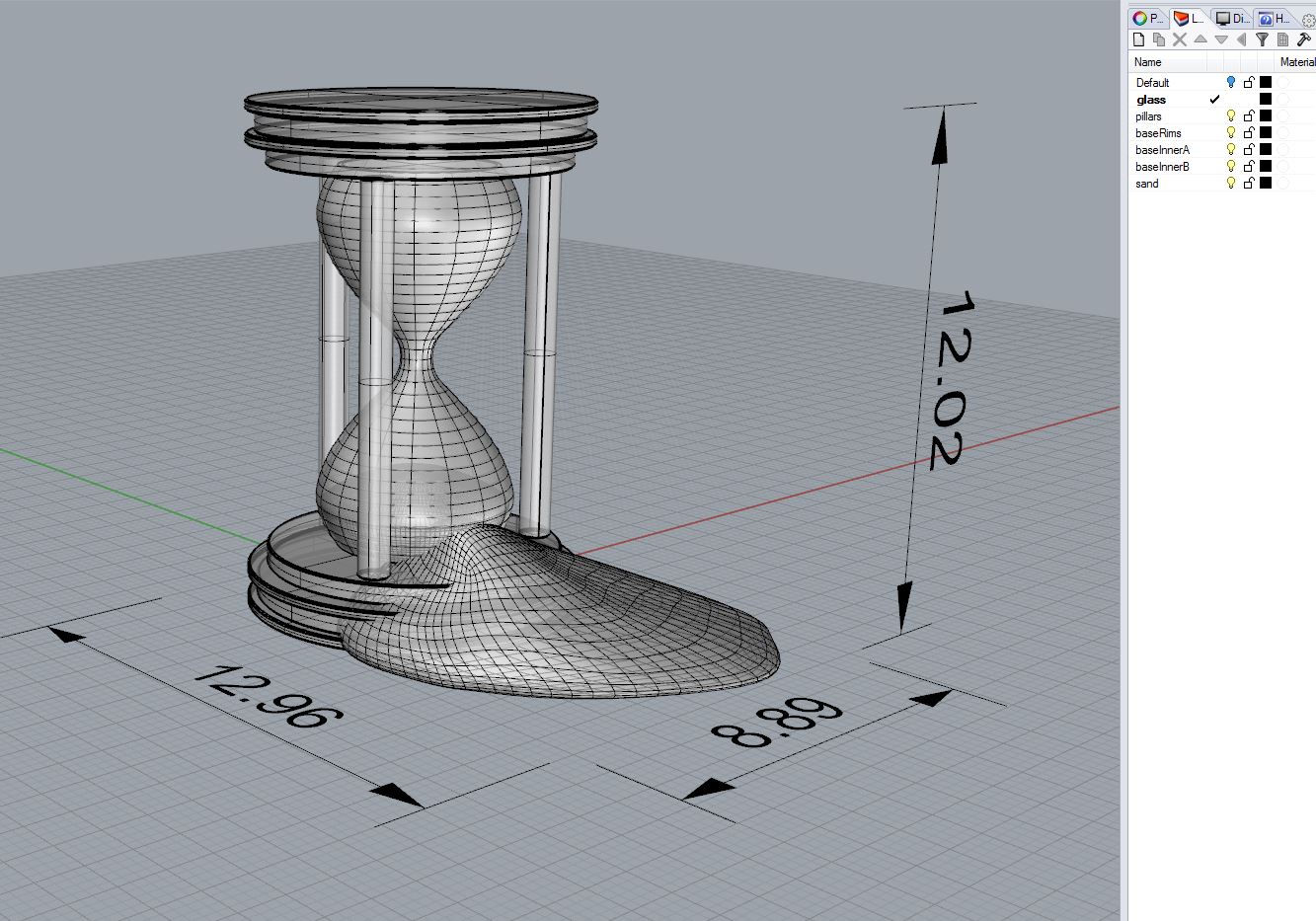
At some point or another, we all find ourselves looking back and thinking "Where did all the time go?," and I wanted to visualize that thought in my piece. Also, I've always been fascinated by the concept of time, so I settled on the hourglass as the main subject. The leaking sand in my sculpture represents the time that "escapes" us whenever we lose track of time.

I modeled the hourglass in Rhino using lots of circular curves. I then used loft to create the surfaces. The Chamfer command was used to create highlights on most of the hourglass pieces. I created the sand within Maya simply by smoothing a cube several times, and then using soft select to shift vertices around.

I chose darker materials for the hourglass because I wanted the sand to pop out as that is a focal point for my piece. At the same time, I used a monochromatic color scheme to unify all the components together. To achieve the sand look, I used one of the marble materials with roughness raised to one.

Sunday, October 11, 2015

Vincent Lo: Week 8 "Breaking Tradition"


With marriage happening all around me, I wanted to capture the moment of proposal in my model. By society’s standards, men are typically the ones to court, to propose. However, I wanted to flip flop the roles as society is changing and traditions are being broken.

I modeled my figure with little defining detail because I wanted the figure to represent any woman. I did not want to add a face or give it hair because that would instill a particular character in the figure, which would go against what I wanted to represent. The figure was modeled in Maya using polygons and lots of vertex snapping.

For my render, I used the glass material because it is a “transparent” material. As in the case of a proposal, I think it’s a moment where one person is being transparent to another. Seeing through that transparency is ideally pure love, which I represented through the red tint of the glass.

Friday, September 25, 2015

Vincent Lo: Week 4 Redo "Struggling with Silence"


Being silent is part of who I am, but sometimes I think it’s a barrier that I struggle with at times. This struggle is what I wanted to capture in my model. Looking inwards is what inspired this model.

I sculpted the head in Zbrush. I decided to add Asian features to capture part of myself in the model. In addition, I used the Flatten tool to chop away pieces of the head to represent the losses that occur when my silence takes over. Sometimes I reflect on times I remained quiet and the regrets just eat away at me. I modeled the zipper in Maya because it was a hard surface object. The zipper represents my struggle to open my mouth at times.


I used the skin material for the face as it showcases my head sculpt in a realistic manner. The zipper has a metallic material to make it stand out against the soft subsurface material of the head. The zipper is supposed to be a focal point, so the contrast of materials helps that component stand out.

Monday, September 21, 2015

Vincent Lo: Week 4 Printable Models - Cat


Instead of having another standalone piece, I wanted to create a model that played off of the girl. I wanted to create something that the girl could interact with, so I chose to make a cat as if it was a surprise/gift for her. The aesthetic is, again, inspired by Happy Wars.

For modeling, I used the same techniques as I did with the girl. I created the cat’s body using curve networks, which allowed me to easily shape it. I then used Boolean and Fillet to get my limbs on. The Boolean/Fillet combo was also used to create the box. The ears were created using loft. The facial features were, again, created using curves and projected onto the head.

For materials, I chose plastic materials for the same reasons as the girl. My model was far from realism. In addition, I wanted to see what my models looked like if they were to be printed using plastic. Colors are bright to match the aesthetic I chose for my model.

Vincent Lo: Week 4 Printable Models - Girl


I decided to model a girl because of my desire to print a character model. The aesthetic was influenced by a game called Happy Wars that I recently discovered, and I really liked the simple, appealing style. I chose this aesthetic to keep things simple for printing.

For modeling, I used Filleting several times to blend the arms, legs, and head with each other. I learned to create surfaces through curve networks by generating profile curves. These helped me create complex shapes with the ability to manipulate their points right after generation, which let me create the dress shape and the arms. I also projected the eyes and mouths, which are curves, onto the head to make sure the curves rested on the surface. Pipe was used to generate the eyelashes.

For materials, I chose plastic materials because my model was far from realism. In addition, I wanted to see what my models looked like if they were to be printed using plastic. Colors are bright to match the aesthetic I chose for my model.